
The Pakistan Army continued shelling along the Line of Control (LoC) in four sectors of Jammu and Kashmir, prompting a befitting response by the Indian Army, officials said on Thursday. The intensity of cross-border firing was less than Wednesday, when Pakistan Army carried out one of the most intense artillery and mortar shelling in years targeting the forward villages in J-K following missile strikes by India as part of 'Operation Sindoor'.

India has to fill in all the critical gaps in missiles, ammunition, sensors and stockpile in the fastest possible manner, focusing on the critical instruments that worked this time, asserts Shekhar Gupta.
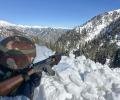
The exchange of fire occurred even though the directors general of military operations of India and Pakistan spoke over the hotline on Tuesday amid rising tensions between the two countries over the Pahalgam terror attack on April 22.
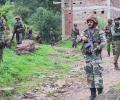
The Indian Army has increased its operational footprint in the Jammu region, including the strategic occupation of the upper reaches of the Pir Panjal range, a senior officer said. The army is playing a pivotal role in military-civilian coordination in creating a stable environment in the region, the officer said, adding that the force will continue its efforts to promote peace, security, and development in the area.

'I am pleased to announce the Governments of India and Pakistan have agreed to an immediate ceasefire and to start talks on a broad set of issues at a neutral site.'
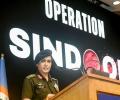
The top court also referred to the distinctions achieved by women officers, and put out an example of Col Qureshi's achievements.
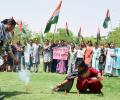
Opposition parties in India, including the Congress, Left parties, Samajwadi Party, Bahujan Samaj Party, Trinamool Congress, Dravida Munnetra Kazhagam, Rashtriya Janata Dal, Shiv Sena (UBT), and NCP (SP), have unanimously hailed the armed forces' "Operation Sindoor", a retaliatory strike against terrorist infrastructure in Pakistan and Pakistan-occupied Kashmir (PoK). The operation, which involved missile and drone strikes, was conducted in response to the April 22 Pahalgam terror attack. Despite political differences, all parties expressed support for the government and the armed forces, stressing the importance of national unity and integrity in the face of terrorism. While emphasizing the need for diplomatic avenues to prevent further escalation, some parties also called for caution in attributing political credit for the strikes.

The announcements were made after a meeting chaired by Prime Minister Shehbaz Sharif to formulate the country's response to India's move to suspend the Indus Water Treaty and downgrade diplomatic ties after the Pahalgam terror attack.

US President Donald Trump on Saturday (local time) said that the United States has launched an attack on three Nuclear sites in Iran.

"We work with other countries to develop their capabilities and support their efforts to make free sovereign choices. More broadly, we aim to advance peace and stability in the region," he asserted.

World leaders, including US President Donald Trump, Russian President Vladimir Putin and Israeli Prime Minister Benjamin Netanyahu, condemned the terror attack in Jammu and Kashmir that killed 26 people, expressing solidarity with India. The attack was claimed by The Resistance Front (TRF), a proxy of the Pakistan-based Lashkar-e-Taiba (LeT) terrorist group. The attack came during US Vice President J D Vance's maiden visit to India. Prime Minister Modi, who had arrived in Saudi Arabia on a two-day visit earlier in the day, cut short his visit and departed for New Delhi on Tuesday night following the attack.

'There is no question that Putin's preference will be to avoid unpleasantness with Trump, leave alone a collision course,' observes Ambassador M K Bhadrakumar.

'Putin dreams about his legacy. He wants to forcibly restore the Russian empire.' 'Unfortunately, after three years of large-scale war with massive human losses, Putin will not budge from his goal because human life is the cheapest resource in the Russian State.'

The US ended up abstaining from the vote for its own resolution at the General Assembly after several amendments were passed ahead of the vote to strengthen the language against Russia and reaffirm Ukraine's territorial integrity.

US Vice President JD Vance called on India to drop non-tariff barriers, give greater access to its markets and buy more American energy products and military hardware. Vance, in a speech in Jaipur, highlighted the need for a stronger US-India partnership for a prosperous and peaceful 21st century. He emphasized the importance of working together to address global challenges and praised Prime Minister Narendra Modi, describing him as a "special person." Vance also urged India to provide greater market access to American products and buy more defense platforms and energy from the US. He suggested that India consider dropping some of the non-tariff barriers for American access to the Indian market and highlighted the benefits of closer India-US defense collaboration, advocating for New Delhi to procure more military hardware from the US. He cited the example of American fifth-generation F-35s, arguing they would give the Indian Air Force the ability to defend its airspace and protect its people like never before. Vance also welcomed the Modi government's budget announcement to amend India's civil nuclear liability laws, paving the way for US producers to export small modular reactors and build larger US-designed reactors in India. He emphasized the importance of energy security for India's AI ambitions, stating "there is no AI future without energy security and energy dominance." Vance's visit comes amid growing global concerns over the US's tariff war.
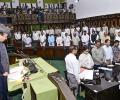
The Jammu and Kashmir Assembly unanimously passed a resolution on Monday expressing shock and anguish over the Pahalgam terrorist attack and resolved to fight resolutely to defeat the nefarious designs to disturb communal harmony and hinder progress.
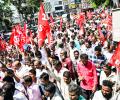
A nationwide strike called by trade unions to protest against the central government's labor policies had a mixed impact across India. While normal life remained largely unaffected in most parts of the country, some sectors like banking, transport, and insurance experienced disruptions. Sporadic incidents of violence were reported in West Bengal.

'The Pakistani government's growing fear of Dr Mahrang's rising popularity is evident.' 'Her defiance is inspiring.'
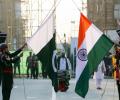
The UN Security Council will hold closed consultations on Monday on the situation between India and Pakistan after Islamabad sought an emergency meeting on the issue. Pakistan, which currently sits as a non-permanent member of the council, requested the meeting in light of rising tensions between the two countries following a terror attack in India. The meeting comes after India's foreign minister spoke with all council members except China and Pakistan, emphasizing the need to bring perpetrators of the attack to justice. The Pakistani envoy has argued that the situation in Jammu and Kashmir poses a threat to regional and international peace and security, justifying the need for a council discussion.

'Had a very fruitful meeting with Iranian defence minister Brigadier General Amir Hatami in Tehran. We discussed regional security issues including Afghanistan and the issues of bilateral cooperation,' Singh said in a tweet.

Authorities in Jammu and Kashmir on Sunday asked border villages residents, who were evacuated to safer places in view of cross border shelling by Pakistan, not to rush back to homes as they are yet to sanitise and clear these areas of any unexplored shells.

Erdogan's skipping of the Kashmir reference is being seen as an apparent shift in Turkiye's stance and comes at a time when the country is trying to become a member of the BRICS grouping to forge alliances beyond the West.

The Supreme Court of India strongly condemned the terrorist attack in Pahalgam, Kashmir, that killed at least 26 people, mostly tourists. The court observed a moment of silence in tribute to the victims and expressed condolences to their families. The attack was described as an affront to the values of humanity and the sanctity of life. The Supreme Court Bar Association and other legal bodies also condemned the attack and expressed solidarity with the victims and their families.

More than 118 Pakistani forward posts and their surveillance system were completely destroyed by the BSF during Operation Sindoor, dealing a major blow to the neighbouring country, Union Home Minister Amit Shah said on Friday.

While the Prime Minister did not spell out the details of the three instances, his remarks are being widely interpreted as a reference to the 2016 surgical strikes following the Uri terror attack, the 2019 Balakot air strikes after the Pulwama bombing, and the recent cross-border strikes as part of 'Operation Sindoor'.

'India for its survival has to change its doctrine from no first use to a pre-emptive attack in case of any hostile move by Pakistan,' recommends Colonel Anil A Athale (retd).
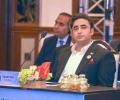
Bhutto, who served as the Foreign Minister earlier, addressed a briefing at the UN Headquarters in New York and sought reconciliation with India, making a plea for talks and Intel sharing between the two neighbours.
An inconclusive end to this war will pose high risk for Netanyahu of a cascading demand for a regime change in Israel, predicts Ambassador M K Bhadrakumar.
'Looking at how quickly the hostilities were escalating, the nuclear threshold did not seem that far.'
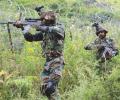
India and Pakistan on Friday held a flag meeting along the Line of Control (LoC) in Jammu and Kashmir's Poonch district in an effort to ease tension after several recent incidents of cross-border firing and an IED attack, official sources said.
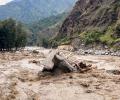
While two bodies were recovered on Wednesday, the death toll climbed to four on Thursday after the recovery of two more bodies from the Indira Priyadarshini Hydroelectric project site in Kangra district.

A female student of primary school was killed in Kaliganj in West Bengal's Nadia district on Monday after bombs were allegedly hurled from a Trinamool Congress victory celebration rally taken out even before the results of the assembly bypoll were officially announced.
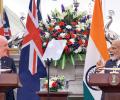
India and New Zealand have signed a pact to institutionalize their defence ties and vowed to boost cooperation in the Indo-Pacific. Prime Minister Narendra Modi raised concerns about anti-India activities by some illegal elements in New Zealand with his Kiwi counterpart Christopher Luxon. The two sides also signed six agreements to enhance cooperation in areas including education, sports, agriculture, and climate change. They also agreed to prepare a roadmap for cooperation in the defence industry sector and explore early implementation of cooperation in the digital payments sector.
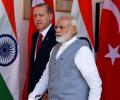
India-Turkiye ties are strained over Ankara's Islamabad tilt, its arms links with Pakistan, and fallout from the Pahalgam terror attack.
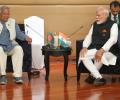
A former Bangladesh army officer and close aide of Chief Adviser Muhammad Yunus has suggested that Dhaka should collaborate with China to occupy India's northeastern states if it attacks Pakistan in response to the Pahalgam terror attack. Bangladesh's interim government has distanced itself from the remarks made by Major General (Retd) ALM Fazlur Rahman on his social media account. Rahman's comments come amidst growing tensions between India and Bangladesh following Yunus' remarks in China about India's northeastern states being landlocked and needing Bangladesh's access to the ocean. These incidents have further strained relations between the two countries, with India withdrawing transhipment facilities granted to Bangladesh for exporting goods to the Middle East, Europe, and various other countries.

Pakistan military spokesperson Lieutenant General Ahmad Sharif Chaudhry told a hurriedly called press conference in Islamabad at around 4 am that th Pakistan air force's Nur Khan (Chaklala, Rawalpindi), Murid (Chakwal) and Rafiqui (Shorkot in Jhang district) airbases were targeted.

'Pick up momentum and find opportunities from an intelligence-sharing standpoint.'
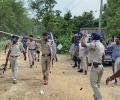
The situation remained tense but peaceful during the day, amid heavy police deployment in the area.

The foreign ministry's statement came amidst the reported visit of Foreign Minister Sun Weidong to Pakistan on a mediation mission.

Union Home Minister Amit Shah has stated that Naxalism, currently confined to just four districts in India, will be completely eradicated by March 31, 2026. He emphasized the crucial role of the Central Reserve Police Force (CRPF), particularly its CoBRA battalion, in achieving this goal. Shah lauded the CRPF's contributions to national security, highlighting their efforts in combating terrorism in Kashmir, maintaining peace in the Northeast, and significantly reducing Naxal violence. He also paid tribute to the CRPF's sacrifices, acknowledging the loss of 2,264 personnel in the line of duty.
